All Your Base Are Built By Us: High tech and high value manufacturing
The new Halley VI research station is the sixth to be built on the floating Brunt Ice Shelf in Antarctica – a region that has established itself as an important natural laboratory for studying the Earth’s magnetic field and the near-space atmosphere. It was data from Halley that led to the 1985 British Antarctic Survay discovery of the ozone hole. In architectural terms, the design by Hugh Broughton Architects is notable for the fashion in which an architectural language has found home in an inhospitable climate. Whereas the “well-serviced sheds” that Reyner Banham described are still discovered humming ominously in business parks, hidden from the green belt by artificial berms, Halley VI has no neighbours – apart from some Emperor Penguins – to worry about. It is intended to have a wider significance however.
On one hand the station is utterly functional. It has to be in a climate when winter temperatures at the base drop as low as -56C. It is a series of seven blue modules used for bedrooms, laboratories, offices and energy plants that are linked together. A central double height red module provides a social space. The GRP cladding was developed through studying Neumayer-Station III, a German base that had used the material. Whilst suiting a very specific task it speaks within a tradition of High Tech and although it is observed by the occasional passing plane heading for the Argentinian base, the base projects the impression in photographic form that the British Antarctic Survey is a progressive institution to the wider world. (Linda Capper, Head of Communications at BAS is married to an architect….)
But is this image a reality? The design of Halley VI is so utterly connected to the harshness of its surroundings and yet it stands out so much against it. Despite the vigorously internationalist outlook of the BAS mission in both practical and philosophical terms, the bases red and blue – against the endless white background – says something about Britishness in a High Tech idiom. Is the architecture of this structure merely a figleaf to British decline as a scientific nation; as an industrial nation? This reviewer believes British design has declined alongside British industrial output.
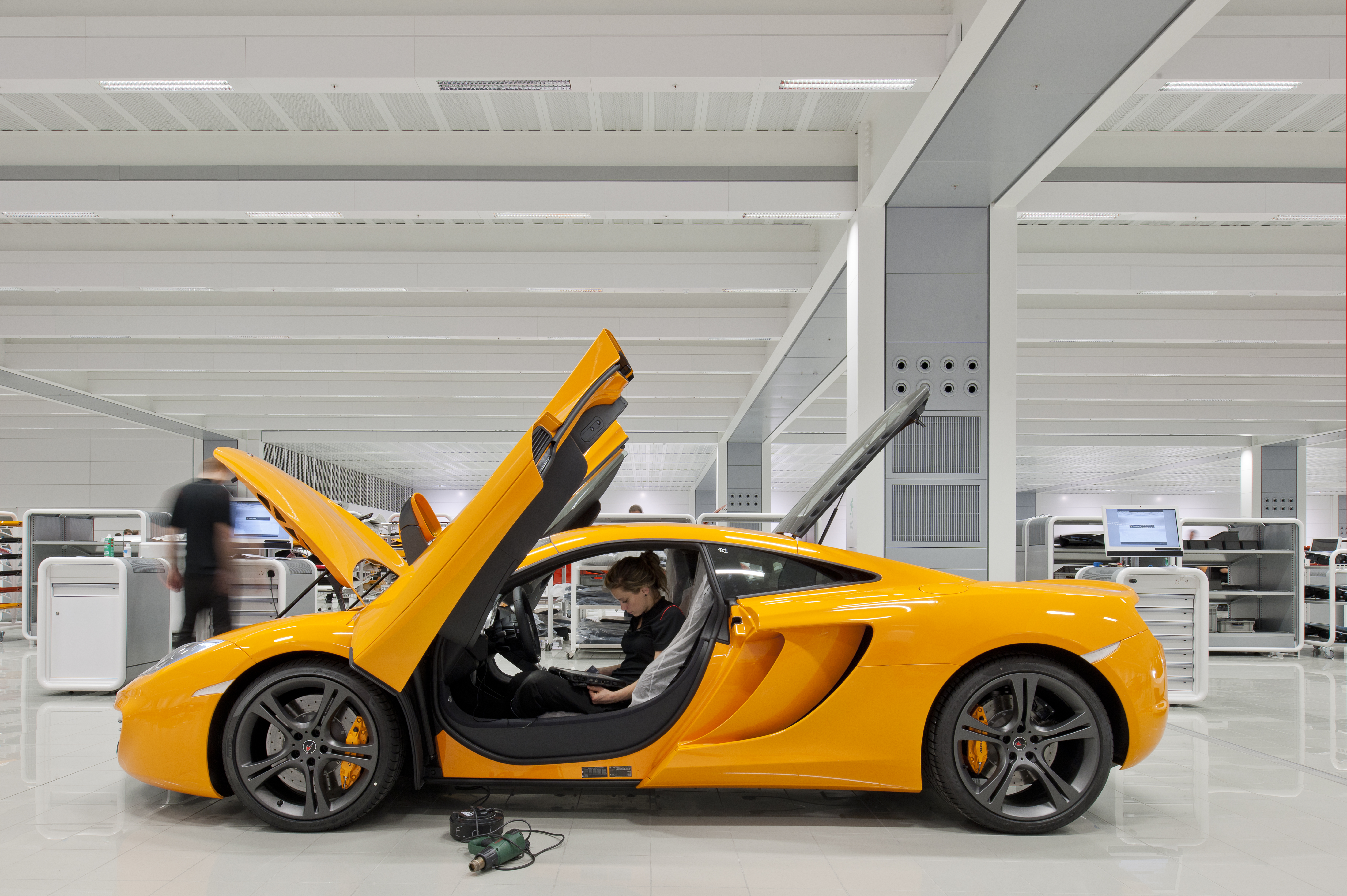
He is wrong. As the BBC former Economic Editor Evan Davis pointed out in his TV series Made in Britain, not only is the UK still the 5th largest industrial nation, but it reached its peak industrial production not in 1890 or even in 1944 but in 2008. Yes, Davis points out, we are no longer the kind of industrial nation which makes multiple machine parts and, although this has negative consequences for permanent, mass employment, it does have positive consequences for wage levels in the face of cheaper foreign labour. Davis argued for a specific kind of industrial manufacture in his series. Standing looking over a £180,000 McLaren MP4-12C sports car he declared ‘this is high value production and it’s what Britain does best’. His backdrop was the recently opened McLaren Production Centre in Woking designed by Foster and Partners.
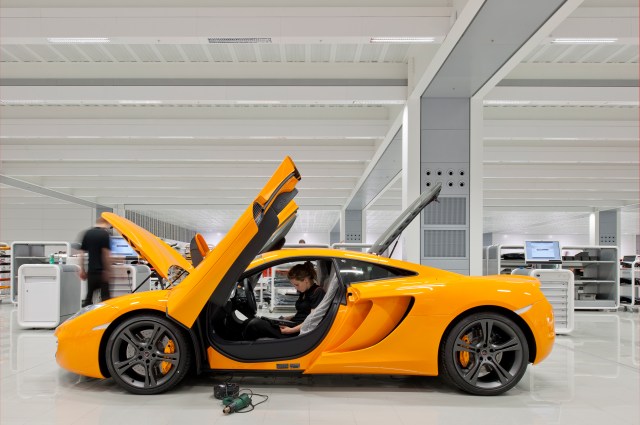
Foster’s building is a sleek, low-slung shed, sited both in plan and in the wider geographical logistics for its relationship to well-engineered road layouts. It is a classic recent example of a particularly British branch of architecture, that has been closely associated with the countries movement from heavy industry to small-scale high value production. The Formula One constructor and now, sports car manufacturer who will produce only 10 MP4-12C’s a day at its Woking base but then each one costs a minimum of £168,500. The car is doing well: riding a surge in car exports due to the changes in exchange rates since 2008. According to the The Society of Motor Manufacturers and Traders, car production in the UK was up 6% in 2011, 2% more than the global average with 80% of all vehicles made in the UK destined for abroad.
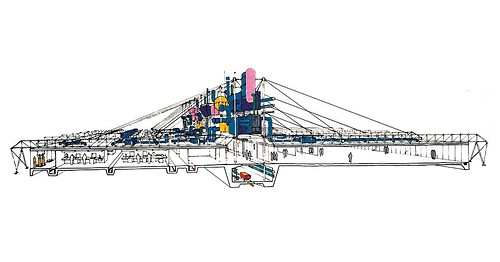
The UK, particularly around the M25 was home to that unique typology that the architecture critic Reyner Banham described as the ‘serviced shed’. Buildings like the PA Technology centre by Richard Rogers, nestle into the semi-rural, off-a-ring-road landscape like the McLaren MPC. The INMOS factory, completed, again by Rogers, in 1987 is a similar type of building: its tubular steel assisted span-tension structure is supported by tension tie rods from a spine of towers. The first of them was probably the Reliance Controls Electronics factory in Swindon built by Team 4, the then Lords Rogers and Fosters with their then wives. It is hard to remember that semi-conductors were once a high-value industry but it goes to show how quickly the UK the manufacturing sector has had to move to remain high-end.

The originators of this approach to architecture have gone on to be incredibly successful in the late 20th century, early 21st century, particularly in the demanding field of airport design. Foster built Beijing and Hong Kong International airport whilst Rogers designed Barajas Airport in Madrid and Heathrow Terminal 5. Both have gone on to create a whole architectural language in which the engineering is on show. In the case of Rogers this has been not just been the structural elements but also the services; pipes and conduits on the outside. Foster, meanwhile pioneered the stashing away and secreting of the technological guts of modern work. He pioneered the integration of IT into the office space rather having it sit in a separate room. At his temporary Head Office for IBM in Portsmouth, he also created sub-floor spaces for the wiring for computing, which is of course now standard practice.
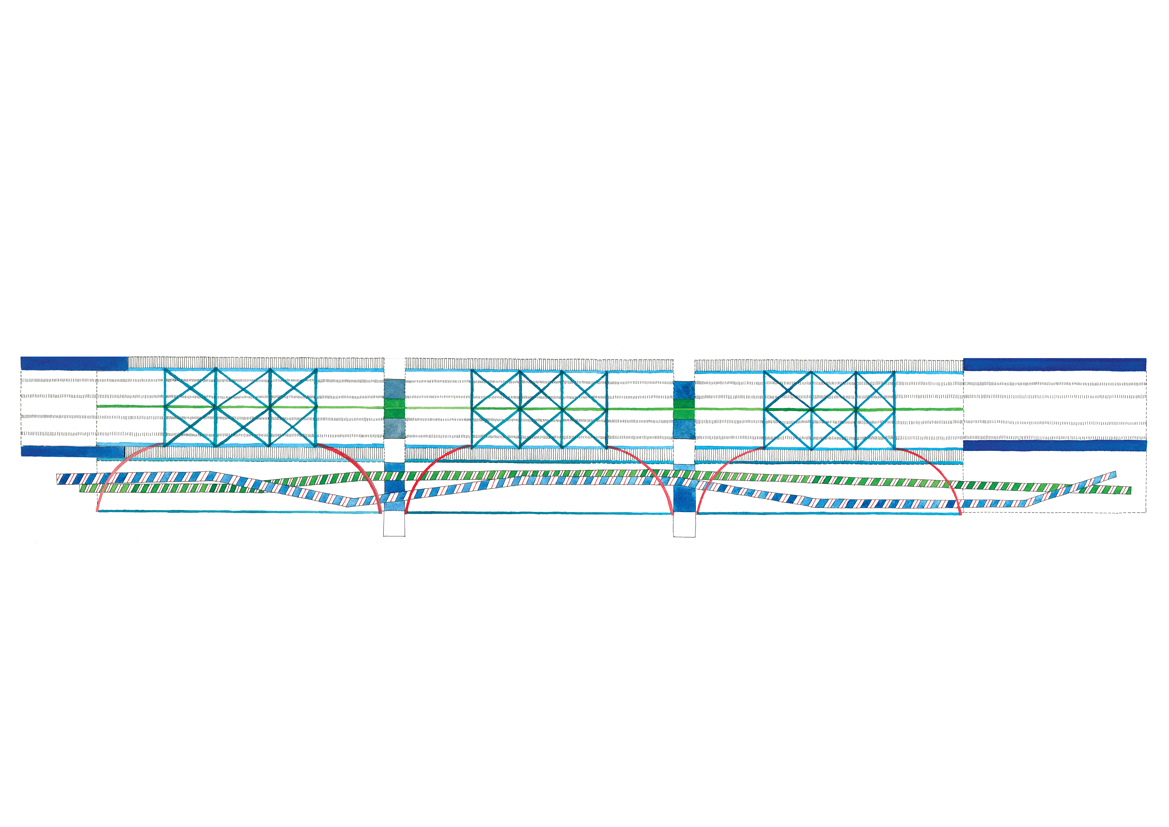
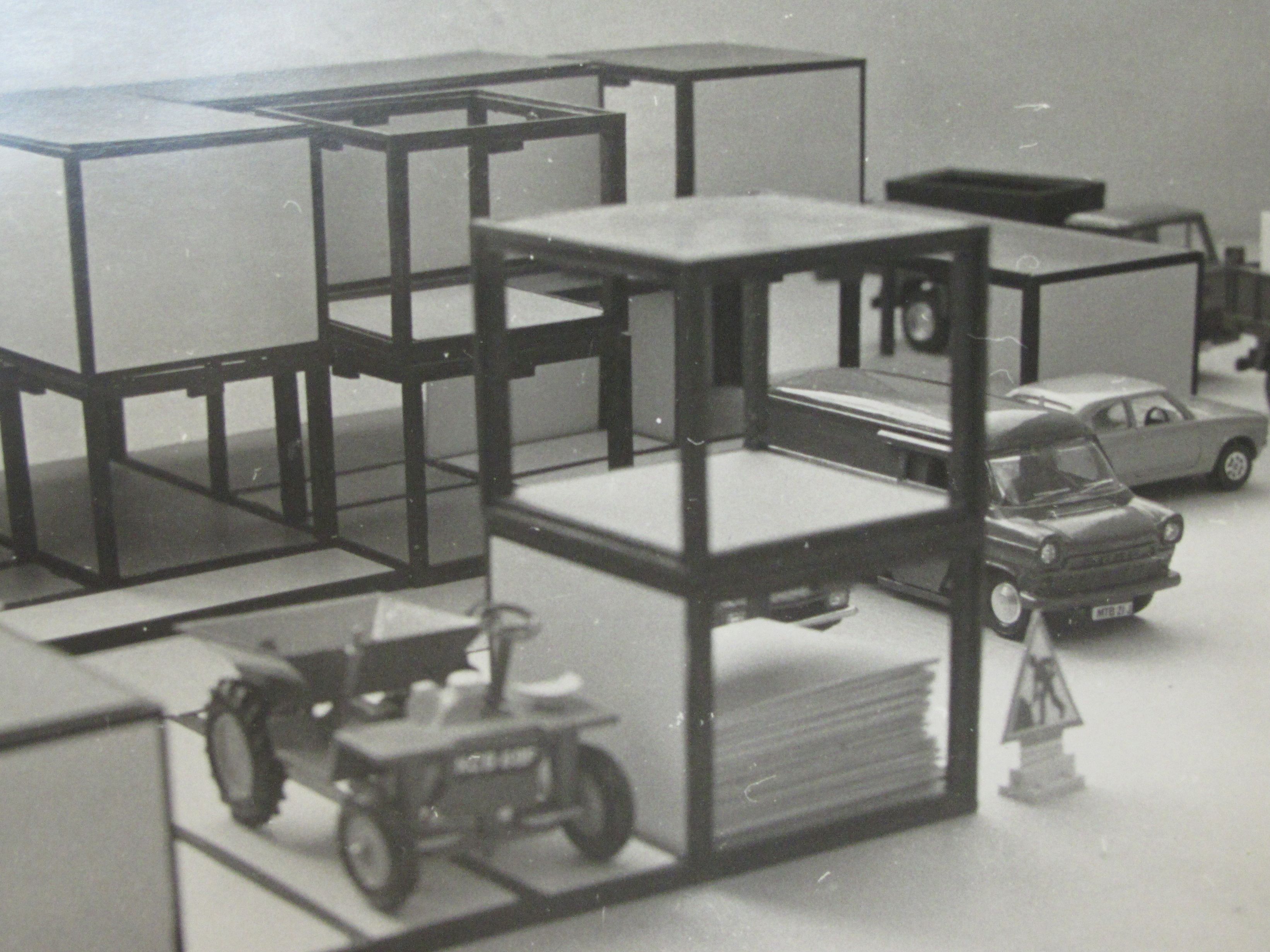
The success in airport design is telling, because another area in which this engineering-led brand of British architecture is in the area of logistics; not simply the way in which an architect is able to organise efficiently the construction of his building but the way in which he can provide and allow for the efficient use of its space subsequently. This was firstly useful in housing manufacturing, but it then became useful the processing of high volumes of human traffic and transport support services. It requires a design system which is not based simply on the plan and section in the classic modernist way but also a diagrammatic way of drawing, designing and thinking.
Cedric Price gave birth to this way of working out the separation of a building’s functions as well as its its actual construction in a visual language borrowed from game-theory and cybernetics. Barnabas Calder has noted how Foster borrowed his early drawing stayle from Price. Other like Nick Grimshaw and Michael Hopkins also used this diagrammatic apporach to conceiving a building, even if they all could turn out a plan and section in the classic way.
This tradition of architecture lives on some astonishing projects today although we have had to move further afield than the M25 to find recourse to it. The Halley VI research base on the Brunt Ice Shelf in Antarctica by Hugh Broughton is conceived not just as a final entity but as a programme of construction. The maximum weight the brittle sea ice that all construction materials must land on is 9 tonnes. Prefabricated modules are made in South Africa to suit this limit. The Ice Shelf moves at a rate of 400m a year. Snow fall is around 1m a year. The new base has skis on hydraulic lift so it can not only be relocated when it gets to the edge of moving flow of ice, but it can also be towed out of the snow trench that has formed around it at the end of the winter. If you create a long building and place it perpendicular to the wind, the snow is dumped on the leeward side, leaving the forward side hard, and ideal for using vehicles on.
The success of Halley VI and the reason we have stayed with it throughout its 8 years of development is because it is an unexpected architectural form that addresses in practical terms an extreme situation; a unique demand created by the movement of ice and wind. It also has a symbolic function – to make a claim for the UK as a place of progress and industry which is fair. The symbolic function is clearly needed. Despite the doom-mongers and nostalgia merchants who see the absence of mills and mines on our landscape and believe we don’t make things any more, we do.






 cosmopolitan scum